
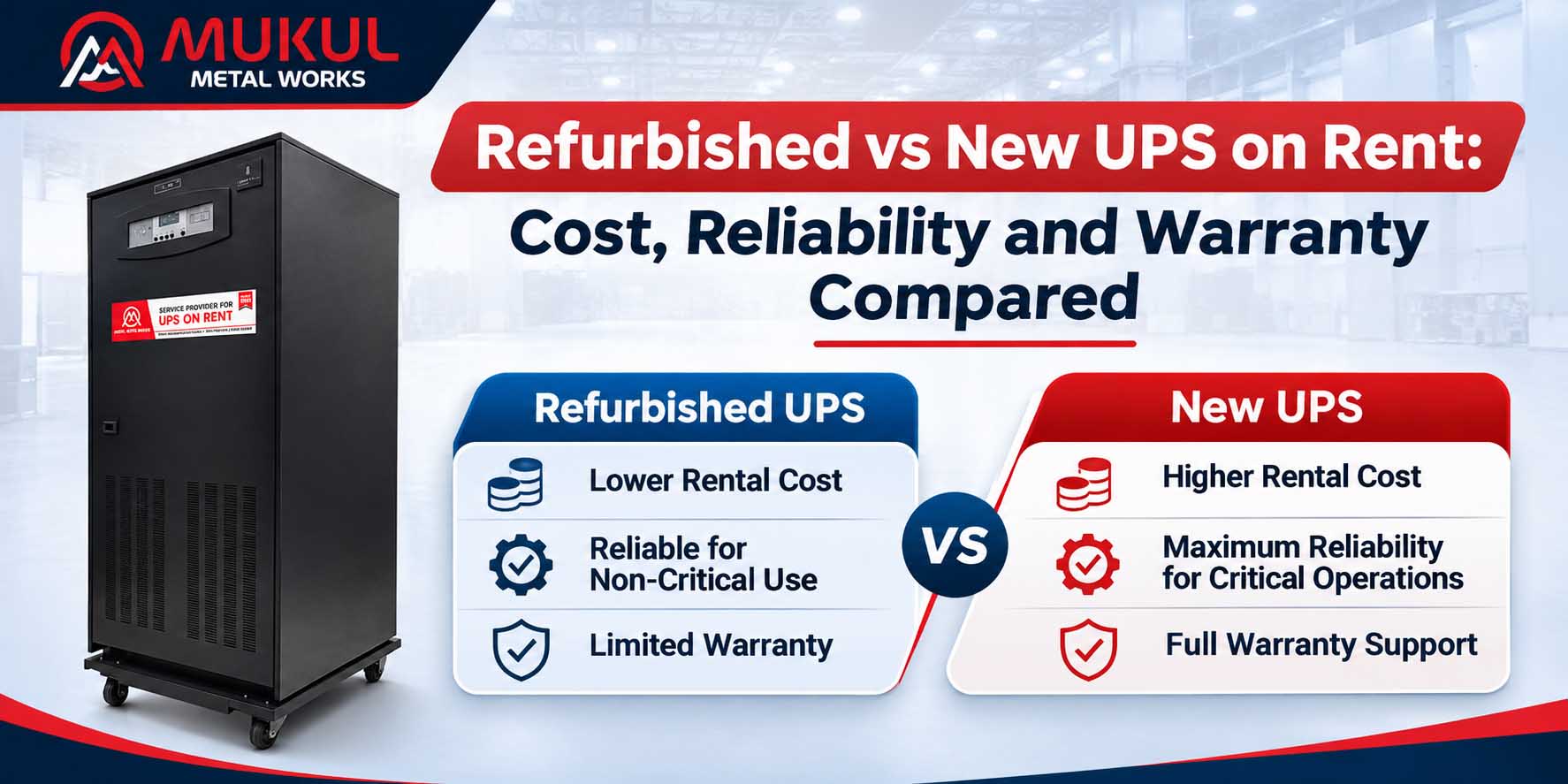
When arranging a UPS on rent for an office, factory, data centre, exhibition, or corporate event, one important question is whether to choose a refurbished UPS or a new UPS.
Both options can provide power backup, but they may differ in rental cost, equipment condition, battery performance, warranty coverage, and maintenance requirements.
For businesses that depend on uninterrupted power, the cheapest rental option is not always the most economical choice. The right decision depends on the application, required backup duration, equipment condition, and the service support offered by the rental provider.
In this guide, Mukul Metal Works explains the key differences between refurbished and new UPS systems on rent to help you make an informed decision.
What Is a New UPS on Rent?
A new UPS is equipment that has not previously been used in normal operation. Renting a new system can be suitable for businesses that require modern equipment, predictable performance, and compatibility with their electrical infrastructure.
A new UPS may be preferred for:
- Critical business operations
- Data centres and server rooms
- Sensitive industrial control systems
- High-value production equipment
- Long-duration projects with strict uptime requirements
- Events where power interruption could cause significant disruption
However, a new UPS is not automatically the best choice for every application. Its suitability still depends on the capacity, configuration, battery arrangement, installation quality, and maintenance support.
What Is a Refurbished UPS on Rent?
A refurbished UPS is previously used equipment that has undergone inspection, servicing, repair, or component replacement to prepare it for further use.
The quality of refurbishment can vary significantly between providers. Some systems may have undergone extensive testing and replacement of ageing components, while others may have received only basic servicing.
Before renting a refurbished UPS, ask the provider about its service history, component replacements, load testing, battery condition, and maintenance arrangements.
A refurbished UPS may be suitable for:
- Temporary office power backup
- Non-critical business applications
- Short-term projects with limited budgets
- Applications where tested equipment meets the required specifications
- Backup requirements where suitable replacement equipment is available
For critical applications, the decision should be based on verified equipment condition and service commitments rather than the refurbished label alone.
Refurbished vs New UPS on Rent: Key Differences
| Comparison factor | New UPS on rent | Refurbished UPS on rent |
| Rental cost | May be higher | May be lower |
| Equipment history | Generally no previous operating history | Has previous usage history |
| Component condition | New components, subject to configuration | Depends on inspection and refurbishment |
| Battery condition | Depends on the battery package supplied | Requires particular attention and testing |
| Reliability | Depends on correct sizing, installation and maintenance | Depends on equipment condition, refurbishment quality and maintenance |
| Warranty | Depends on the rental agreement and provider | Depends on the rental agreement and provider |
| Maintenance | Service arrangements still need confirmation | Service arrangements and replacement policies need particular attention |
| Best suited for | Applications prioritising new equipment | Cost-sensitive applications where verified condition meets requirements |
Important: Neither new nor refurbished equipment guarantees uninterrupted operation. Proper sizing, installation, testing, and technical support are essential for both.
- Cost: Which UPS Rental Option Is More Economical?
Cost is often the first factor businesses consider when comparing UPS rental options.
A refurbished UPS may have a lower rental price because the equipment has already been used. A new UPS may command a higher rental price depending on its capacity, model, battery configuration, and service package.
However, the monthly rental amount does not tell the whole story.
Before choosing a system, compare:
- Monthly or project-based rental charges
- Transportation and installation costs
- Battery bank and accessory charges
- Preventive maintenance costs
- Emergency service charges
- Replacement equipment terms
- Minimum rental duration and deposit requirements
For example, a refurbished UPS may initially cost less to rent, but frequent service visits or an unsuitable battery arrangement could increase the total cost of operation.
A new UPS may cost more but could be the better option if the rental agreement includes suitable support and the system meets the project’s requirements.
Best approach: Compare the total rental cost for the complete project, not just the quoted equipment price.
- Reliability: Which UPS Is More Dependable?
Reliability is particularly important for factories, hospitals, server rooms, production facilities, and large events.
A new UPS generally avoids the uncertainty associated with previous equipment usage. However, installation errors, incorrect sizing, unsuitable batteries, and inadequate maintenance can still cause problems.
A refurbished UPS can also be dependable if it has been properly inspected, serviced, tested, and configured for the intended load.
Before renting either option, confirm the following:
- The UPS has sufficient kVA and kW capacity.
- The system supports the required load characteristics.
- Battery runtime has been assessed at the expected load.
- Transfer operation and alarms have been tested.
- Cooling and ventilation requirements are satisfied.
- Maintenance and emergency support are available.
- The equipment is compatible with the site’s generator and electrical infrastructure, where applicable.
For refurbished equipment, also ask for the refurbishment date, service history, test results, and details of any replaced components.
For critical operations, consider redundancy or an alternative backup arrangement where appropriate. Equipment age alone is not a sufficient measure of reliability.
- Battery Condition: A Critical Factor in UPS Rental
The battery system plays a major role in determining how long a UPS can supply power during an outage.
A refurbished UPS may have new batteries, older batteries, or a mixture of components depending on the rental package. The condition of the batteries should never be assumed from the UPS’s external appearance.
Ask your rental provider:
- Are the batteries new or previously used?
- What battery type and configuration are included?
- Has battery capacity or runtime been tested?
- What runtime is expected at the proposed load?
- What happens if the batteries fail during the rental period?
- Are battery replacement and service charges included?
A UPS with a suitable rating but an inadequate battery bank may not provide the required backup duration.
For both new and refurbished systems, request an estimated runtime at your actual connected load rather than relying on a generic battery backup claim.
- Warranty and Service Support: What Should You Check?
Warranty terms for rented UPS equipment differ from those for purchased equipment. The rental agreement may specify maintenance, repairs, replacement equipment, exclusions, and emergency response arrangements.
Do not assume that a refurbished UPS has no warranty or that a new UPS rental automatically includes comprehensive coverage.
Before signing the agreement, confirm:
Coverage period: How long does the service or equipment warranty apply during the rental?
Included components: Are batteries, fans, power modules, control boards, and other components covered?
Repair responsibility: Who pays for repairs arising from normal equipment failure?
Replacement policy: Will a replacement UPS be supplied if the rented system cannot be repaired promptly?
Response time: How quickly will technical support respond to an urgent issue?
Exclusions: Are misuse, overloading, unsuitable environmental conditions, or external electrical faults excluded?
For temporary projects and critical business applications, clear replacement and emergency support terms can be more valuable than a low rental price alone.
- Which Option Should You Choose for Your Business?
Choose a new UPS on rent when:
- The application has strict continuity requirements.
- You need modern equipment with a known usage history.
- The project involves sensitive or high-value equipment.
- The rental agreement offers suitable warranty and service coverage.
- The cost difference is reasonable compared with the operational risk.
Consider a refurbished UPS on rent when:
- The application is less critical.
- The rental budget is limited.
- The equipment has documented service and testing records.
- Battery condition and expected runtime are verified.
- The provider offers clear maintenance and replacement terms.
A refurbished system should not be selected simply because it is cheaper. Its condition and suitability must be established before installation.
- UPS Rental Recommendations by Application
| Application | What to prioritise |
| Office computers and networking | Suitable capacity, battery runtime and service support |
| Factory automation and PLCs | Compatibility, transfer performance and controlled shutdown |
| Data centres and server rooms | Verified performance, monitoring, redundancy and response commitments |
| Exhibitions and corporate events | Pre-event testing, load assessment and quick technical support |
| Hospitals and other critical facilities | Application-specific engineering, redundancy and documented service arrangements |
| Temporary construction or project sites | Environmental suitability, equipment condition and practical rental cost |
The appropriate choice depends on the consequences of a power interruption. Some applications require a dedicated engineering assessment rather than a standard rental package.
- Checklist Before Renting a Refurbished or New UPS
Use this checklist before confirming your rental:
Confirm the required UPS capacity in kVA and kW.
Calculate the connected load and expected peak demand.
Specify the required backup duration.
Ask for the UPS model, rating, and equipment condition.
Request battery details and a runtime estimate.
Confirm testing and commissioning before handover.
Review maintenance, warranty, and repair responsibilities.
Confirm the emergency response and replacement policy.
Check transportation, installation, and removal charges.
Get the complete rental terms in writing.
This checklist helps you compare quotations on an equivalent basis and reduces the chance of unexpected expenses during the rental period.
Why Choose Mukul Metal Works for UPS Rental?
Mukul Metal Works offers UPS rental solutions for industrial, commercial, exhibition, and event applications.
Selecting the right rental arrangement starts with understanding the connected load, backup duration, operating environment, and consequences of a power interruption.
Whether you are evaluating a new UPS or a refurbished system, ask for a configuration that meets your technical requirements and comes with clearly defined service arrangements.
Our team can discuss your power backup requirements and help you evaluate suitable rental options, subject to equipment availability and site requirements.
Visit https://mukulmetalworks.com/ to discuss your UPS rental requirements.
Frequently Asked Questions
Is a refurbished UPS safe to rent?
It can be suitable when the equipment has been properly inspected, tested, and maintained. Confirm the electrical condition, battery performance, installation requirements, and service support before renting.
Is a new UPS always more reliable than a refurbished UPS?
Not necessarily. A new UPS has no previous operating history, but reliability also depends on design, installation, operating conditions, and maintenance. A well-refurbished system can perform reliably when it is suitable for the intended application.
Does a refurbished UPS rental include a warranty?
Warranty and service coverage depend on the rental provider and the written agreement. Confirm the coverage period, included components, repair responsibilities, and replacement arrangements before booking.
Which UPS is better for a factory?
For a factory, the right option depends on the machinery, automation systems, critical loads, and backup duration. Sensitive control systems may need dedicated UPS protection, while heavy machinery may require a separate generator or an appropriately engineered power backup arrangement.
Is a new UPS worth the additional rental cost?
It may be worthwhile when equipment history, project criticality, service arrangements, and operational risk justify the extra cost. Compare the complete rental package rather than the equipment’s age alone.
Conclusion
Choosing between a refurbished and a new UPS on rent requires more than comparing prices. Equipment condition, battery performance, runtime, service support, and replacement terms all affect the value of the rental.
For less critical applications, a properly tested refurbished UPS may be a practical option. For applications with strict uptime requirements, a new UPS may be preferable when supported by an appropriate service agreement.
The best choice is the system that meets your actual power requirements, provides the required backup duration, and comes with dependable technical support.
Contact Mukul Metal Works to discuss UPS rental solutions for your business, factory, exhibition, or event.


